
Extending its losses for the fourth straight session, equity benchmark Sensex slumped 427 points on Friday, tracking weakness in Bajaj Finserv, L&T and Infosys amid a widespread sell-off in global markets. Relentless foreign fund outflows further weighed on the bourses, traders said. The 30-share BSE index ended 427.44 points or 0.72 per cent lower at 59,037.18. Similarly, the NSE Nifty plunged 139.85 points or 0.79 per cent to 17,617.15.

Equity benchmarks had another rough day on Monday, with the Sensex plummeting 1,457 points and the Nifty tumbling to the 15,774 level, mirroring an extremely weak trend in global markets along with unrelenting foreign fund outflows. Index majors ICICI Bank, Infosys and Reliance Industries bore the brunt of heavy selling. The 30-share BSE Sensex tumbled 1,456.74 points or 2.68 per cent to settle at 52,846.70.

There's sustained demand for the American currency from importers and banks

Dealers attributed the fall to the dollar's gains after China devalued yuan, which pushed up demand from importers for the US currency.

The ownership by domestic investors, individual as well as institutional, in companies listed on the National Stock Exchange (NSE) has breached the 25 per cent mark for the first time. The share stood at 25.72 per cent at the end of the March 2023 quarter, up from 24.44 per cent in the previous quarter, according to data from Prime Database. The share of foreign portfolio investors (FPIs), meanwhile, rose slightly to 20.56 per cent from 20.24 per cent as on December 31, 2022.

Benchmark indices ended on a flat note on Thursday as fag-end selling wiped out intra-day gains amid weak global trends. The BSE benchmark Sensex slipped 8.03 points or 0.02 per cent to settle at 53,018.94. During the day, it had gained 350.57 points or 0.66 per cent to 53,377.54. Similarly, the broader NSE Nifty fell 18.85 points or 0.12 per cent to close at 15,780.25.

Investors are anxious over the US-China trade tension, a sharp devaluation in yuan and uncertainty over Kashmir issue.

The rupee extended its losses and slumped 60 paise to close at a record low of 77.50 (provisional) against the US dollar on Monday, pressured by the strength of the American currency overseas and unabated foreign fund outflows. Forex traders said risk appetite has weakened amid mounting concerns about inflation that may trigger more aggressive rate hikes by global central banks. At the interbank foreign exchange market, the rupee opened lower at 77.17 against the greenback, and finally settled for the day at 77.50, down 60 paise over its previous close.

Sustained demand for the dollar is the reason.

The rupee fell by 41 paise to close at a fresh lifetime low of 79.36 (provisional) against the US dollar on Tuesday amid a strong greenback overseas and unrelenting foreign fund outflows. At the interbank forex market, the local unit opened at 79.04 against the greenback and witnessed an intra-day high of 79.02 and a low of 79.38. It finally settled at 79.36 (provisional), down 41 paise over its previous close.
.jpg)
Top sources in RBI blamed 'unwarranted rumours' about controls on foreign institutional investors' money to the nearly 770 point drop in the benchmark Sensex and rupee dipping to its lowest levels.

Healthy demand for the American unit from importers and corporate weighed on the rupee

Sentiment took a dramatic change particularly in the last one hour of trading with the lower opening of the European markets and investors booking profits in broader markets at record levels

'Investors need to expect steady returns over the next one to two years with bouts of high volatility.'

Equity benchmark Sensex rebounded 454 points on Thursday, boosted by gains in index heavyweight Reliance Industries amid a positive trend in global markets.

If you looked back at 2018 and had to give it a name, the Year of Limitations might be the most accurate.

'India's sizeable foreign exchange reserves should serve as a buffer.'

A weak dollar overseas failed to restrict the rupee's decline, a forex dealer said.

Rupee hits more than two-year low; RBI intervenes

The rupee depreciated 6 paise to 77.50 against the US dollar in the opening trade on Wednesday as a surging American currency in the overseas markets and persistent foreign fund outflows weighed on investor sentiment. Besides, rising global crude prices impacted the domestic unit, forex traders said. However, a higher opening in the domestic equity market restricted the rupee's fall, they added.

Moody's and Fitch on Thursday downgraded Russia's sovereign rating to 'junk' grade following severe sanctions by western countries. While Moody's Investors Service downgraded Russia's long-term issuer and senior unsecured (local-and foreign-currency) debt ratings to 'B3' from 'Baa3', Fitch pulled down the rating on the country to 'B' from 'BBB', putting it on 'Rating Watch Negative'. The downgraded rating is in speculative or junk category reflecting default risk. It signifies that even through financial commitments are currently being met, the sovereign is vulnerable to high credit risk.

Investors remained cautious in the face of the expiry of November series contracts in the derivatives segment, which also dampened sentiment.

India's current account slipped into a deficit of $9.6 billion or 1.3 per cent of GDP in the September quarter, the Reserve Bank said on Friday. The current account, which records the value of exports and imports of both goods and services along with international transfers of capital, was in a surplus mode both in the quarter-ago and year-ago periods. India's current account surplus had stood at $6.6 billion or 0.9 per cent of GDP in the April-June 2021 quarter, while in the year-ago period (Q2FY22), the surplus had stood at $15.3 billion or 2.4 per cent of the GDP, the data said.

The rupee is trading weak against the dollar in afternoon trade.

Equity indices nursed losses for the second consecutive session on Tuesday as investors continued to dump IT, banking and FMCG stocks amid a bearish trend in global markets. Unabated foreign fund outflows and the rupee dropping to another record low against the US dollar added to the woes, traders said. Participants were also in wait-and watch mode ahead of release of retail inflation and factory output data.

Indian corporates might face higher borrowing cost in the overseas market in short-run due to the Greek debt crisis.

Weak equity markets too hit rupee sentiment

Volatile currency market sentiment across Asia following a fresh round of China's yuan depreciation further added to gloom.

HUL was the top loser in the Sensex pack, shedding around 4 per cent, followed by Maruti, HDFC Bank, PowerGrid, IndusInd Bank, HCL Tech and Bajaj Finserv. On the other hand, Axis Bank, SBI, ONGC and ICICI Bank were among the gainers. NSE Nifty fell 149.95 points to 13,817.55.

Sharp rate hike in Russia further raised concerns about the global economy.

The Securities and Exchange Board of India's (Sebi's) board on Wednesday allowed foreign portfolio investors (FPIs) to trade in exchange-traded commodity derivatives. The move, it said, "will enhance liquidity and market depth, as well as promote efficient price discovery." Overseas investors will only be allowed to deal in non-agricultural commodity derivatives and only cash-settled contracts.
.jpg)
Else, more capital outflow and pressure on rupee likely.

The global brokerage firm believes that CRR cut is likely to help cut lending rates and revive growth sentiments.

The rupee rose by 12 paise to close at 79.78 against the US dollar on Monday due to a weak dollar in overseas markets and an improved appetite for riskier assets. Stronger regional currencies also supported the rupee sentiment ahead of the US Fed policy decision on Wednesday. Weak domestic equities and FII outflows, however, capped sharp gains. At the inter-bank forex market, the local unit opened at 79.86 against the greenback and moved in a range of 79.70 to 79.87 in the day trade.

Whatever the critics may say, the numbers suggest that India continues to be a favourite destination for foreign investors.

In worldwide trade, the US dollar retreated from its recent multi-year highs to trade subdued against major rival currencies

NSE Nifty, after shuttling between 10,809.60 and 10,725.90, finished 30.95 points, or 0.29 per cent lower at 10,741.10.
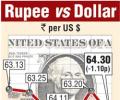
The local currency recovered some ground after the Reserve Bank of India (RBI) was said to have stepped in through state-run banks, helping the rupee to end at 64.30, a fall of 110 paise or 1.74 per cent.

Titan was the top loser in the Sensex pack, shedding over 3 per cent, followed by M&M, HUL, Maruti, Asian Paints and IndusInd Bank. Nifty fell 91 points to 17,157.40.

BSE benchmark Sensex nursed losses on Friday as investors pocketed gains after a five-session winning streak amid a bearish trend overseas. A depreciating rupee and foreign fund outflows further soured risk sentiment, traders said. The 30-share gauge, which had started the trade on a firm note, soon gave up all the gains and finally ended 651.85 points or 1.08 per cent lower at 59,646.15. The broader NSE Nifty snapped its eight-day rally to close at 17,758.45, down 198.05 points or 1.10 per cent.
